I don’t want to make it sound like this is all a piece of cake. If you own a boat you expect things to go wrong. That is part of the fun, figuring it all out. And sometimes it is not so fun and you feel really really dumb and it can be very humbling when you make mistakes. So here is my biggest scariest mistake.
First, you need to know a bit about anchoring. Gorge Harbour is a large bay with a busy resort on one cove, the docks and mooring buoys full and many boats at anchor. Finding a place to anchor is a challenge. You need enough room to swing on the anchor without hitting other boats and objects, enough anchor chain or rode to keep the anchor set and a way to get the anchor down and up. We have 275 feet of heavy chain connected to our 130 # anchor. Too heavy to pull up and down by hand, it requires a windlass, an electric/hydraulic winch. I will try to explain how this works so bear with me. We have two anchors. We only need to use one of them in most situations. Each anchor has a chain locker. The chain comes up from the locker, wraps over its own “gypsy”, a cylinder with grooves into which the chain links fall when the gypsy is turned by the windlass motor. Then the chain attaches to the anchor which sits at the bow of the boat. Since we don’t want to lower both anchors at the same time, the gypsies have clutches that tighten or loosen so that you can choose which gypsy the motor of the windlass will turn, pulling the chosen anchor into or out of the locker.
At Gorge Harbour, the water is deep enough, we needed to use almost all of the anchor chain. After lowering the anchor once, Pat decided we were drifting too close to another boat. So I raised the anchor and we moved a bit further away. When I started lowering the anchor again, it suddenly started dropping super fast, the chain charging into the water with no control. If Pat had not acted so fast, we would have lost the anchor and probably damaged the boat. He 1st tried to stop it with his foot and was lucky he didn’t lose his foot or worse. He then quickly tighten the clutch on the windlass and was able to stop the chain just before it was about to run out. My mistake, which will never be repeated, was not tightening the clutch before starting to lower the anchor in the 1st place. My only consolation is that I am not the 1st person to make this mistake. Google “runaway anchor” to see a great example of a navy ship losing it’s chain and anchor on a much larger scale.
Here is a list of a few other problems we had to address during the trip:
The hydraulics to the steering systems. This required a 2 day stop in Campbell River to visit a ship mechanic.
The autopilot. Patrick was busy texting and calling the electronics companies and the electronics specialist that installed our new navigation system to try to get this fixed. It is better but, still a work in progress.
The batteries. The batteries on a 15 year old boat age even though the boat hasn’t been used. They are old and tired are not charging completely. We will probably need to replace them next year. Meanwhile, the generator was needed to recharge them enough to keep the refrigerator/freezer running (and all the rest of the electrical needs: water and head pumps, navigation electronics, windlass, lights, microwave, starter motor, tender crane, etc. etc. etc)
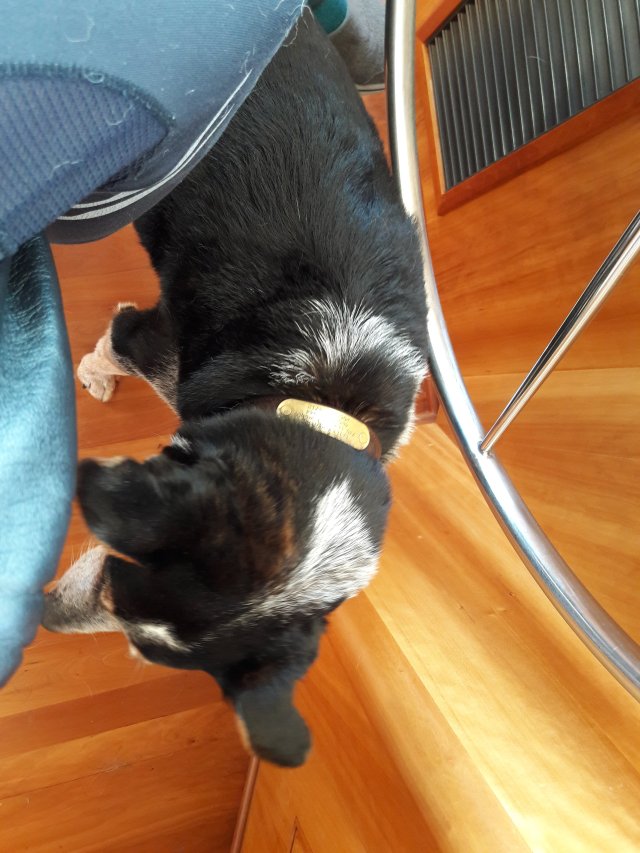
The water and other pumps. Bailey likes to chew on sticks but, rotting logs are his favorite. One day, I flushed the dog’s poop which looked a bit like beauty bark that day. Pat has better ears than I and pointed out that the head pump was running continuously and at risk for burning out. Beauty bark was not meant to go down the head!
The crane that lifts the dinghy down to the water from the fly bridge. This is another long scary story that will have to wait for another day.
The last issue I can think of is that Bailey has anxiety when the boat is moving. He has found a way to stop the boat. To be continued.
 Holeinthewater